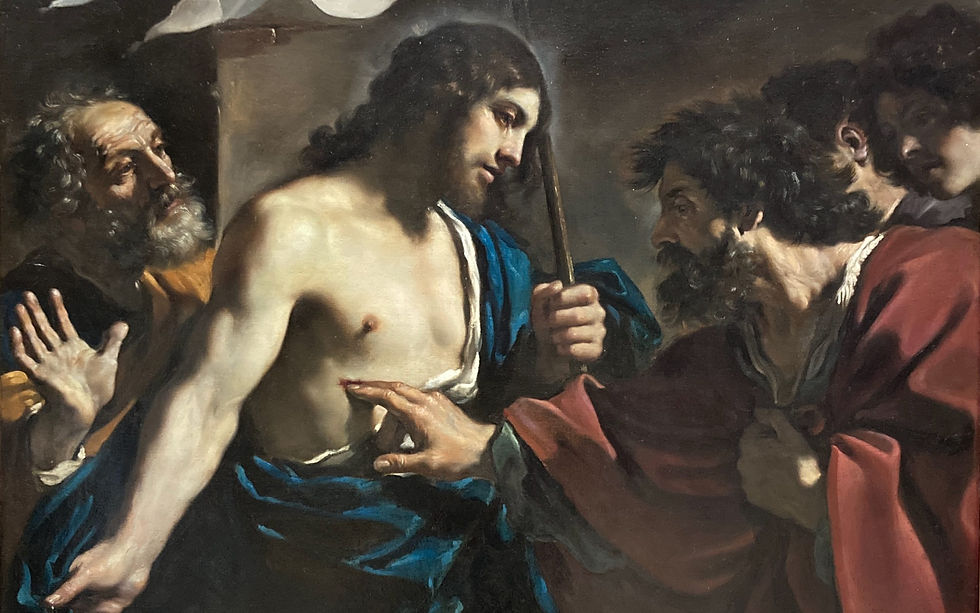
Guercino (1591-1666). The Incredulity of Saint Thomas. 1621. Cropped. The National Gallery, London, UK. Photo by Tom Faletti, 28 May 2025.
Tom Faletti
April 6, 2026
Read John 20:19-23 Jesus appears to the disciples (but Thomas is not there)
Why are the doors locked?
What does this tell you about how the disciples are feeling?
What is the first thing Jesus says to them?
Although “Peace be with you” was a standard greeting among Jews, why is it a particularly appropriate greeting at this point?
When have you experienced the peace of Jesus and what difference did it make?
How do we sometimes hide beyond locked doors, figuratively, and how can Jesus’s peace free us?
Why do you think Jesus shows them his hands and his side (verse 20)?
This shows that it is the same person, Jesus. But it also shows that his resurrected body is the same body that was crucified for us, not a new body.
How do the disciples react, and why?
Notice that Jesus’s resurrected body can go through locked doors or appear in some other way, but it still shows his scars. It’s still his body, not some new body.
Why do you think Jesus says “Peace be with you” again in verse 21?
John does not tell the story of Pentecost, where the Holy Spirit is given widely to the church. He focuses on this moment, where Jesus imparts the Holy Spirit to his inner circle of disciples. Why is this moment important?
In verse 21, Jesus says, “As the Father has sent me, so I send you.” What does he mean when he says he “sends” them, and why is that important?
The word “sent” can be interpreted in various ways. One way to think about it is this: John never uses the word “apostle” to describe the disciples, but “apostle” means “one who is sent,” and here Jesus is “sending” them. So John may see this as the moment when they are commissioned as apostles.
Is what ways does Jesus still send his followers out today?
Why is being sent out by Jesus linked with the giving of the Holy Spirit? How is the Holy Spirit central as followers of Jesus are commissioned or sent out?
In verse 22, Jesus breathes on them and says, “Receive the Holy Spirit.” What is the significance of his breathing on them?
John does not describe what happens, and whatever happened inside of them was more important than whatever it looked like on the outside. What do you think happened, inside of them?
How have you received, or how do you experience, the Holy Spirit?
In John 14:25-27, Jesus said that he would send the Holy Spirit and then added, “Peace I leave with you; my peace I give to you.” Why is the Holy Spirit so intimately associated with peace?
In verse 23, Jesus says, “If you forgive the sins of anyone, they are forgiven them; if you retain any, they are retained.” What does this mean?
How do you see this ministry of forgiveness in the church today?
In Matthew 16:19 there is no reference to the Holy Spirit when Jesus imparts the power to forgive sins, but John places it at the same moment as the giving of the Holy Spirit. Why is the Holy Spirit so central to the forgiveness of sins?
Read John 20:24-29 Thomas does not believe the disciples until Jesus appears again while he is there
Recall that Thomas is the one who, when Jesus said he was going back to Jerusalem, said, “Let us also go, that we may die with him” (John 11:16). What does that tell you about Thomas?
Thomas is a solid, committed follower of Jesus. His faith is not erratic or capricious. He is the kind of person who is willing to face the facts but wants to know all the facts so that he can be a fully committed disciple.
None of the disciples, other than John, believed that Jesus had risen until they saw him alive. Why do you think Thomas did not believe them when they said they had seen Jesus?
Thomas gets a bad rap for his doubts, forever earning the moniker “The Doubting Thomas.” Would you have believed it if your friends said they had seen your dead leader alive again, or would you have wanted to see it for yourself?
Why do you think Thomas specifically said he needed to see and touch the nail marks and the wound in his side?
What does the fact that Jesus appears to them despite the locked doors tell you about his resurrected body?
Jesus again begins with “Peace be with you.” Where do you need to hear those words, “Peace be with you,” from Jesus right now in your life?
Jesus takes Thomas seriously and meets him where he’s at, offering his hands and side to Thomas. What does that tell you about Jesus’s patience with us in our times of doubt?
How has God responded when you needed an assurance that he is real?
Jesus then urges Thomas to believe (verse 27). How does God do that in your life?
Thomas’s answer, “My Lord and my God” (verse 28), is not just a statement that he now believes Jesus is alive; it is a statement of faith declaring who Jesus is. What does it mean when Thomas calls Jesus his “Lord”?
When Thomas says, “my God,” he takes a step further than any other human has taken in the Gospels. Until now, only Jesus has said he is God. The disciples, even in their breakthrough moments, have only declared him to be the Messiah, the Son of God, the Holy One of God. (The title “Lord” was often applied to humans, so it is not a clear declaration of divinity.) Thomas calls Jesus “God.” Why do you think it is Thomas who first says clearly that Jesus is God?
When John gives us Thomas’s declaration that Jesus is God, it is a central point about Jesus that he first stated in the very first verse of his Gospel: that “the Word” – i.e., Jesus – is God (1:1). Skeptics claim that the disciples did not think Jesus was God. How would you respond?
See Who Was the First to Say Jesus is God? for more on Thomas’s role as the first person to explicitly say that Jesus is God.
We sometimes suppress our doubts rather than confronting them. How can wrestling honestly with our doubts lead to insights and spiritual advances that might never happen if we didn’t voice our doubts?
God can handle your doubts. Are there any doubts you could bring to him right now, and let him respond, as Jesus responded to Thomas?
Jesus’s final comment here (verse 29) is, “Blessed are those who have not seen and yet have believed.” He is not rebuking Thomas but encouraging people in the following generations, including us. What does this blessing from Jesus say to you?
You have never seen Jesus, nor the nail marks in his hands, nor the wound in his side. Why do you believe?
What do you need to hear from the risen Lord right now?
Read John 20:30-31 Conclusion
These verses provide a conclusion to John’s Gospel. Chapter 21 serves as an epilogue that, at least in its final verses, was added by others in his community.
In verses 30-31, what does John say about the stories he hasn’t told us in this Gospel?
What does John say his purpose was in writing this Gospel?
John hoped that by reading his Gospel you would believe and have life (verse 31). Do you? Is there anything that might help you believe more or experience more fully the life Jesus offers you? What might your next step be?
Take a step back and consider this:
It is very common for people to pick one incident in a person’s life and act like that little story tells you everything you need to know about the person. Or they may focus on one incident in an event and ignore the bigger picture of what happened.
The apostle Thomas is known mostly for this incident where he expressed his doubts, while his years of formation with Jesus are ignored and his decades of ministry preaching the Gospel in many foreign lands are forgotten.
Similarly, people remember far more about Jesus’s appearance to Thomas than they do about his first appearance to the disciples the evening of his resurrection.
John certainly wanted us to hear Jesus’s blessing on those who have not seen but believe: few eyewitnesses to the risen Jesus were still alive.
But he would not have wanted us to miss the rest of the story:
Jesus called his followers to be at peace.
He gave them the Holy Spirit.
He sent them forth.
He gave them a ministry of forgiveness of sins.
Let us keep the whole story in mind.
In his first appearance to the disciples, Jesus called them to be at peace, gave them the Holy Spirit, sent them forth, and gave them a ministry of forgiveness of sins. Which of those do you feel needs special attention in your life today, and why?
Which needs greater attention among the followers of Jesus today, and why?
If you look beyond a moment of doubting and see the whole Thomas, what can you learn from him and apply in your own life?
Bibliography
See John - Bibliography at https://www.faithexplored.com/john/bibliography.
Copyright © 2026, Tom Faletti (Faith Explored, www.faithexplored.com). This material may be reproduced in whole or in part without alteration, for nonprofit use, provided such reproductions are not sold and include this copyright notice or a similar acknowledgement that includes a reference to Faith Explored and www.faithexplored.com. See www.faithexplored.com for more materials like this.