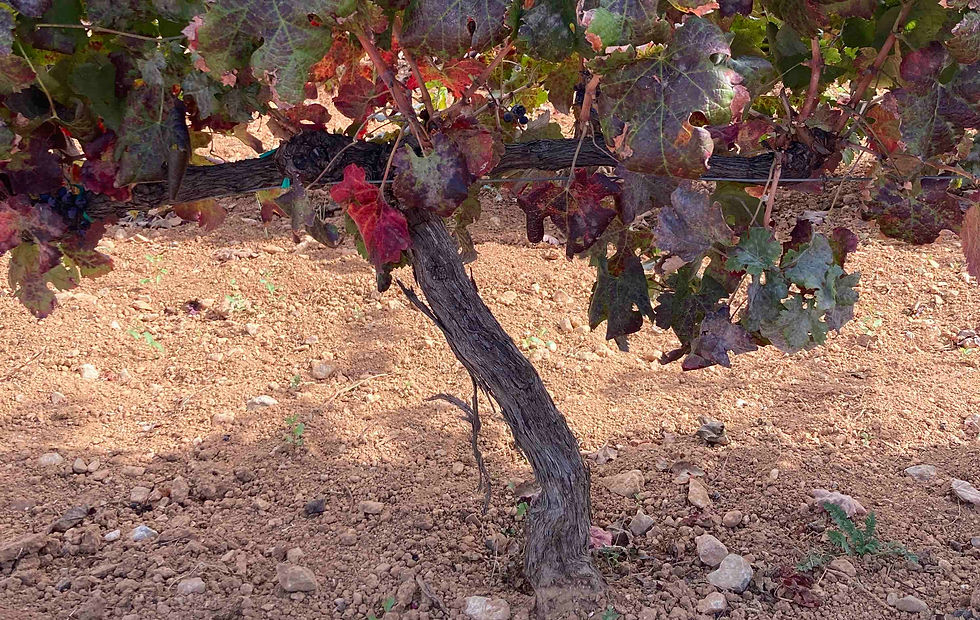
A grapevine at Gikas Winery, Spata, Greece. Photo by Tom Faletti, 3 Nov. 2023.
Tom Faletti
June 7, 2026
Read John 15:1-11 I am the vine; abide in me
The Greek word menó is central to this passage. It means to abide, to remain, to stay, to live or dwell somewhere. The most common translations are to “remain” or “abide,” although to “stay” or “dwell’ also communicate the key connotation that you are continuing “in” a particular place or position – in this case, in a particular Someone and his love.
Jesus uses this word 6 times in verses 4 through 7, urging us to abide in himself. He also uses it once in verse 7, calling on us to let his words stay in us, and 3 times in verses 9-10, telling us to remain in his love.
To introduce us to the concept of abiding or remaining in him, Jesus gives us an image of a branch of a vine, which needs to remain attached to the vine to stay alive. What does that image tell us about what it means to “remain” or “abide” in him?
The word “abide,” or “remain,” always implies a place: you abide or remain somewhere. Where does Jesus want us to remain or abide?
In verse 1, Jesus says that he is the “true” vine. He may be using the word “true” to distinguish himself from Old Testament uses of that metaphor. In the Old Testament, Israel is described as God’s vineyard (Is. 5:1-7; Is. 27:2-6; Jer. 12:10-12) and God’s vine (Ps. 80:8-16 [80:9-17 in the NABRE]; Jer. 2:21). Now, Jesus says that he is God’s vine, the one and only vine in God’s vineyard. In what ways is Jesus the “true” vine?
Israel was an imperfect and fickle vine – the people and their leaders did not stay true to their commitment God. Jesus can be counted on forever, and we can find life in him and through him forever.
In verse 1, Jesus says that his Father is the vine-grower or vinedresser. He is referring to the kind of farmer who cultivates a grapevine, tends it, waters it, and prunes it. How is God the Father like a vine-grower?
In what ways is this metaphor of the vine and branches appropriate for us? How is Jesus like a vine, and how are we like his branches?
In verse 4, Jesus says, “Abide in me.” What does it mean to abide “in” Jesus? Why is that word “in” so important?
How do you picture yourself abiding in Jesus? What image do you have in your mind as a symbol or picture of abiding in him?
What do you do to help yourself to continue to abide in Jesus?
There are many things we can do: prayer, Bible study, praise, gratitude, service, united our sufferings with his, sacrificing ourselves for others with a conscience focus on staying connected to Jesus. Our participation in Holy Communion is also a way to abide in Jesus. The same word “abide” that Jesus uses here, at the Last Supper, he also uses in the Bread of Life discourse in John 6:56, where he says, “The one who eats my flesh and drinks my blood abides in me, and I in him.” This suggests that our sharing in the Eucharist/the Lord’s Supper can help us to abide in him.
What kinds of things happen that take us away from abiding in Jesus?
Now let’s look at the rest of what Jesus says in this passage.
What does Jesus say about the Father in verse 1? How does that add to the image of what God is doing?
Verse 2 has two parts. First, Jesus says that the vine-grower removes the branches that do not bear fruit. Why is that necessary for a vine?
A diseased branch can infect the good branches and cause them also to stop bearing fruit.
In what way does this apply to people? Why is it necessary to remove the branches that do not bear fruit? Are such people not really connected to the vine in the first place? Or is a separation necessary because a life that does not bear fruit is a contradiction that is incompatible with abiding in Jesus? Explain.
Both of these are possible. Some people adopt the label “Christian” but never actually commit to living with and for Jesus. God will not force them to live forever with him when they have not chosen to do so; sooner or later, there must be a separation. There are also times when false prophets must be identified so that the Body of Christ is not led astray.
Second, he prunes the branches that do bear fruit. Why is pruning necessary for a vine?
If we are seeking to abide in Jesus, we should not need to be removed from the vine; but everyone needs pruning. What does it mean for us to be “pruned” by God?
God seeks to remove everything in us that is not compatible with a life of intimate communion with God: our selfishness and self-centeredness in all the ways it shows up in unloving actions, words, and attitudes; the ways we fail to handle the truth accurately; the ways we fail to live in faith, hope, and love; etc. Our calling is to be become fully like Jesus (Eph. 4:13; Col. 1:28). Everything that falls short of that must eventually be pruned away so that we reflect Christ entirely.
How can we cooperate with God’s pruning in our lives?
In verse 3, Jesus says that the disciples are already pruned. According to verse 3, how have they already been pruned?
By his word.
In what ways are we already pruned even though in other ways we still need pruning?
In verse 5, what does Jesus say will happen if we abide in him?
What are some examples of fruit that you are already bearing? What are some examples of fruit that you are not yet producing but that he may still want you to bear?
In Galatians 5:22-23, Paul provides a list of the “fruit of the Spirit”: some of the interior dispositions that the Spirit works in us that then flow out into our actions. When we see that fruit in action in our lives, then we know that we are grounded in the Spirit. The Bible also points us to universal values such as justice and peace that come from the heart of God. When we respond to the promptings of the Spirit to try to address issues of justice and peace in our world so that God’s justice and peace can prevail, we are bringing forth the fruit of a life rooted in the heart of Jesus.
In verse 5, Jesus says, “apart from me you can do nothing.” People do lots of good things. Even atheists do good things. In what sense is Jesus’s statement true? What is it that can’t be done apart from him?
By using the metaphor of a vine, Jesus tells us that we cannot live or have growth unless we remain connected to him. If a branch is severed from a tree or vine, it stops growing and dies. The branch is absolutely dependent on the vine. What lessons can we draw for ourselves from this metaphor?
What is the point of verse 6? Why must the branches that don’t bear any fruit be thrown out?
People assume that God is doing the “throwing out” in verse 6, but Jesus doesn’t identify God as the actor. He simply takes it as an obvious fact that those who show no evidence (fruit) of a connection with Jesus can’t stay connected to him. Why is that so?
Verse 7 is similar to 14:13-14 (“whatever you ask in my name, I will do”), but this time Jesus is saying that the criteria for receiving what we ask is (1) that we remain in him, and (2) that his words remain in us. How do we do that? What do these two requirements look like in practical terms?
Why is it so important to abide in him and allow his words to abide in us, as a precondition for effective prayer?
Verse 8 seems to be directed more to the people of John’s time and to us, rather than to those he has already identified as his disciples. What does this say to us? How is bearing fruit related to being a disciple of Jesus?
In Jesus’s metaphor, there is only one vine. We are not separate trees in an orchard; we are separate branches on one vine. What are our obligations to each other as members of one vine?
How does my growth and fruitfulness affect yours, and vice versa?
When we live as Jesus’s disciples and bear fruit, Jesus says that the Father is glorified (verse 8). How does what we do in our lives glorify God?
In verse 9, Jesus turns to the importance of remaining in his love. What does it mean to abide in or remain in his love?
In verse 10, what does he say is the evidence that we are remaining in his love?
How does this verse challenge you in how you live your life?
In verse 11, Jesus changes the focus again. What does he say about joy?
Jesus wants his joy to be in us and our joy to be complete. How are those related?
How does our experience of the joy of the Lord relate to whether we are abiding in him or not?
How does our experience of the joy of the Lord relate to whether we are keeping his commandments (including the commandment to love one another) or not?
How does our experience of the joy of the Lord relate to the fact that Jesus loves us?
What would it look like for our joy to be complete?
Read John 15:12-17 Love one another as I love you
What is Jesus’s command?
Who is he telling us to love?
Why do you think it matters so much to Jesus that we love one another?
What does it look like in practice when we love one another?
What is the connection between abiding in Jesus, which Jesus talked about in the previous passage, and loving one another? How are they connected?
What is a new step you could take this week to love someone who has been hard to love?
Why does Jesus call us his “friends” in verses 14-15?
How does it make you feel, knowing that Jesus calls us his friends?
How can you be the kind of friend Jesus wants you to be?
Take a step back and consider this:
When Jesus tells us to abide in him and to love one another, neither of those is a “one-size-fits-all” proposition. How we abide in him and love another will look different from person to person.
We will have some things in common. We are all called to pray, to learn about God through his Word, to see Jesus in those around us who are in need, and to be connected to a local church or Christian community.
But people may pray differently, have different ways of studying God’s Word, respond differently to the needs around them, and find different ways of being involved in the Christian community. We are not identical automatons. Paul explores this in his ode to the Body of Christ: we are not all hands; the body needs feet and ears and eyes (1 Cor. 12:12-31). Each of us is made in the image of God, but each of us has our own talents, gifts, interests, and opportunities to manifest that image of God. Even as we abide in the one Lord, we have different callings. So how we love others and how we abide in Christ will vary.
What are the specific practices or ministries that God has called you to, that you need to be faithful to if you want to stay rooted in Christ?
As you do those things, what can you do to make sure that you are maintaining a vital, abiding relationship with God, not just engaging in external actions? How do you keep abiding in him?
One of the ways we love others is by encouraging others in the specific ways that they are called to abide in God and bear fruit. How can you help those around you to embracing the callings they have received from God, so that they, too, are abiding in Jesus?
Bibliography
See John - Bibliography at https://www.faithexplored.com/john/bibliography.
Copyright © 2026, Tom Faletti (Faith Explored, www.faithexplored.com). This material may be reproduced in whole or in part without alteration, for nonprofit use, provided such reproductions are not sold and include this copyright notice or a similar acknowledgement that includes a reference to Faith Explored and www.faithexplored.com. See www.faithexplored.com for more materials like this.